The Antifragility of Tyre Degradation: Complex Systems in Formula 1
Why engineering artificial vulnerability into tyre compounds creates systemic resilience and strategic entropy.
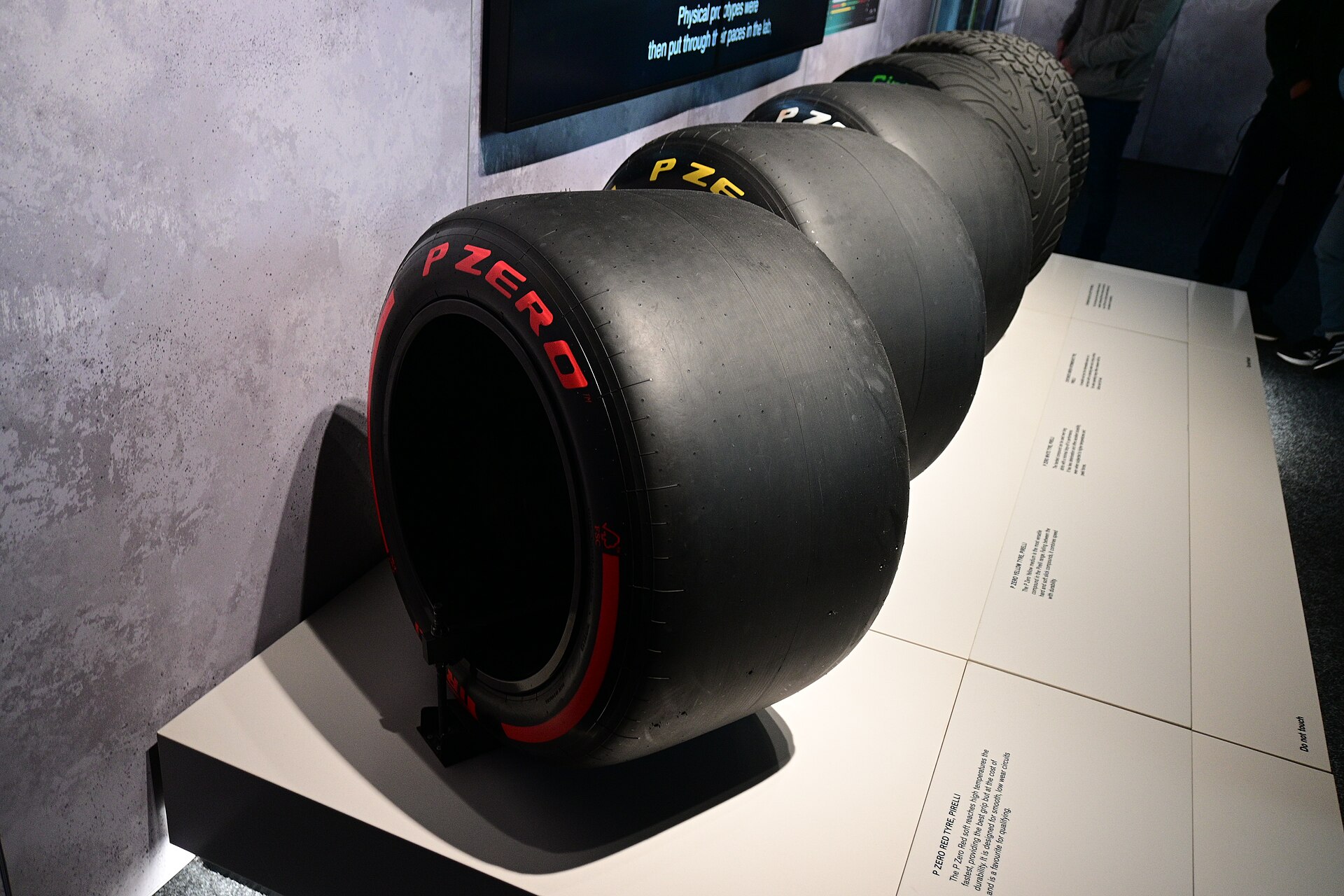
Core Thesis
Engineering intuition demands building the most durable, indestructible tyre possible. Complex systems science proves that artificial fragility in a single mechanical component is what prevents the broader sporting contest from collapsing into a mathematically solved, rigid stalemate.
Why Doubling Load Does Not Double Grip
Cornering force rises with vertical load along a concave curve, not a straight line. The gap between the two is the surplus that becomes slip, and slip becomes heat.
The Brittle Perfection of the Indestructible Tyre
During the Bridgestone and Michelin tyre war of the early 2000s, rubber compounds were engineered to last an entire race distance without significant thermal fall-off. In 2004 and 2005, Bridgestone manufactured tyres capable of completing 300 kilometers while setting qualifying-pace laps.
The result was sporting paralysis: races were decided on Saturday qualifying and pit lane refuelling timing. With no thermal degradation, drivers could push flat-out on identical trajectories, eliminating speed differentials and reducing on-track overtakes to single digits.
Taleb’s Antifragility Triad Applied to Racing
In Antifragile, Nassim Nicholas Taleb defines the fragile as that which dislikes volatility, the robust as that which resists it, and the antifragile as that which benefits from disorder and stress. A Formula 1 race run on indestructible tyres is fragile: any minor disturbance (a processional qualifying order) locks the outcome in place permanently.
By mandating tyres engineered with deliberate polymer vulnerability (steep degradation slopes and thermal cliff points), the sport introduces controlled volatility into the contact patch. The system becomes responsive to temperature spikes, safety cars, and driver tyre-saving discipline.
Thermal Blistering vs Carcass Wear
Tyre degradation is not simple tread depletion. Carroll Smith, in Tune to Win, notes that tyre grip is governed by the contact patch friction coefficient, which peaks in a narrow operating temperature window (typically 100°C to 110°C for modern compounds).
When a car follows another through high-speed turns in dirty air, downforce drops by 20%, causing the tyres to slide laterally across the asphalt. Friction spikes the surface bulk temperature past 118°C within two laps. The polymer bonds weaken, rubber tears away in blisters, and lap times collapse by 1.5 to 2.5 seconds.
The Strategic Barbell: Optionality on Lap 40
Degradation slopes create the strategic barbell. Instead of every team converging on identical 55-lap single-stint trajectories, degradation opens mathematical crossover windows. A driver who pits on lap 18 for fresh rubber emerges lapping two seconds faster than the leader on 25-lap-old tyres.
This tyre delta creates natural overtaking opportunities on circuits where aerodynamic dirty air would otherwise make passing impossible. The instability of the tyre is the exact mechanism that generates sporting dynamism.
Why Engineering Perfection Destroys Entertainment
The lesson of modern Formula 1 tyre chemistry is that local perfection damages global performance. If tyre manufacturers are allowed to build the ultimate technical tyre, the sporting system dies.
By enforcing artificial degradation, the FIA forces engineers and drivers to become risk managers, balancing tyre slip angles, brake bias modulation, and clean air positioning to survive the stint.
The Non-Linear Tyre Law: Added Load Does Not Buy Added Grip
Adrian Newey states the governing fact early in his account of chassis design. Tyres are non-linear, so doubling the vertical load does not double cornering force. A heavier car does not corner harder. Grip grows more slowly than the load that produces it.
That single curve explains why degradation compounds rather than accumulates. Load rises with fuel mass, with downforce, and with every kerb strike. Grip fails to keep pace. The surplus becomes slip, and slip becomes heat in the contact patch. The thermal cliff is a load problem before it is a rubber problem.
Newey's corner model adds the second lever. A corner runs straight-line braking, then combined entry where the driver brakes and turns, then pure cornering, then combined exit. The critical loads sit on the outside front tyre in combined entry and the outside rear in combined exit. A driver who asks one tyre to brake and steer at once loads it twice. The stint shortens before the compound is blamed.
Foundational Literature on this Topic
Essential volumes on engineering, systems design, and sporting strategy.
Tune to Win
Why it matters: Straightforward race engineer advice on chassis tuning and handling balance.
Classic, practical engineering thinking on spring rates, damper valving, and roll center geometry from legendary race engineer Carroll Smith.
Find Edition & Availability →Total Competition: Lessons in Strategy from Formula One
Why it matters: The tactical architecture behind the Schumacher Ferrari dominance and Brawn GP.
An insider analysis of Formula 1 strategy, team structure, and sporting politics by the technical director who orchestrated championships at Benetton, Ferrari, and Brawn GP.
Find Edition & Availability →Race Car Vehicle Dynamics
Why it matters: The gold standard reference on suspension kinematics, tyre slip angles, and vehicle handling.
Foundational motorsport dynamics volume detailing lateral load transfer, tyre contact patch mechanics, and cornering balance.
Find Edition & Availability →Full Grid is reader-supported. When you purchase through links on our site, we may earn an affiliate commission at no extra cost to you. Editorial analysis, telemetry data, and sporting derivations remain strictly independent.