The 1.8-Second Pit Stop: Cockpit Resource Management under Extreme Load
Why sub-two-second wheel changes fail through sensory channel saturation rather than mechanical error.
Core Thesis
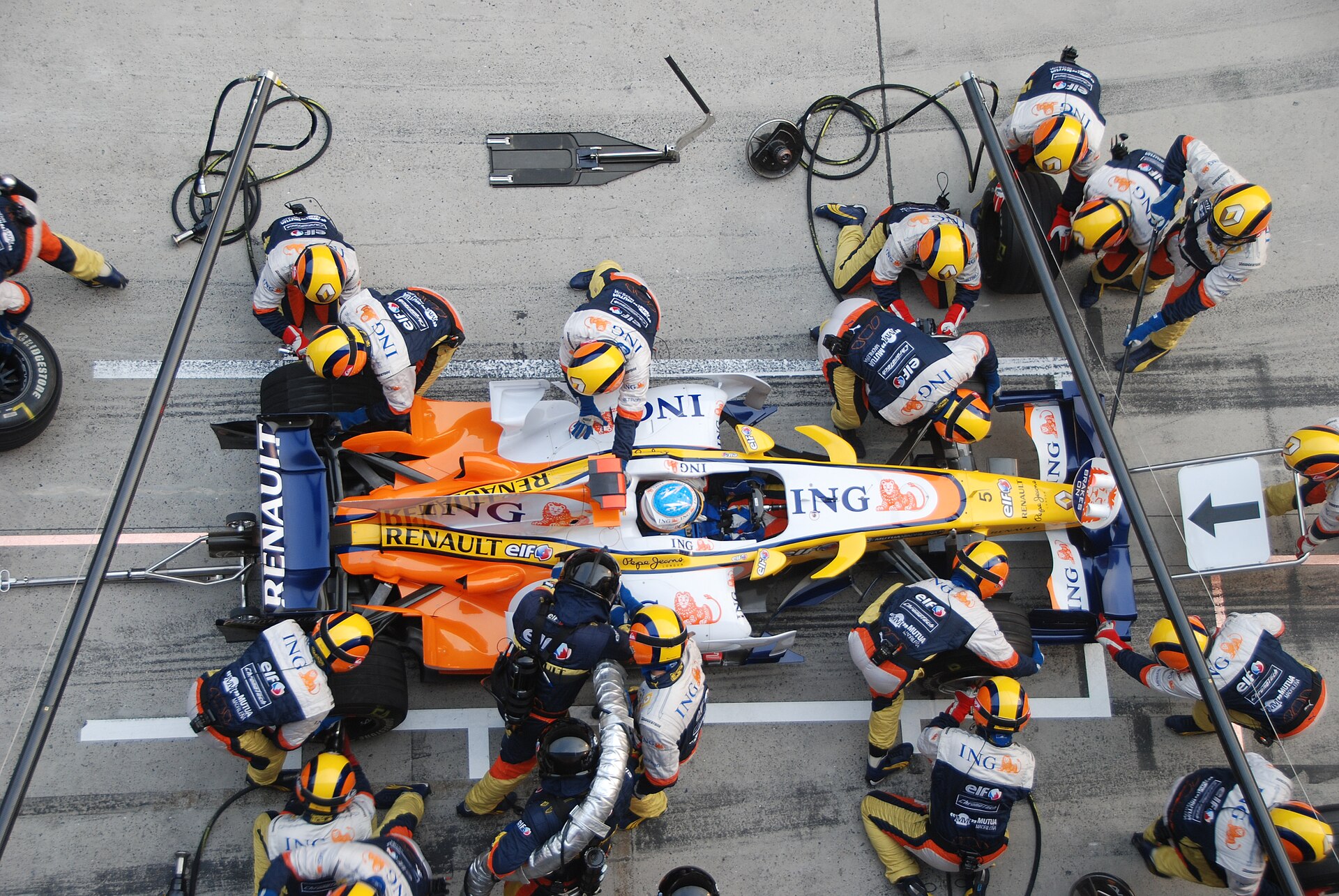
A modern Formula 1 pit stop compresses 22 human actors into an operational window shorter than an eye blink. When pit stops fail, the breakdown is almost never mechanical failure or physical fatigue; it is cognitive channel overload and sensory handoff failure.
Stationary Time Against Crew Size
Adding hands reduces the stop until the coordination limit, then reversal. The three markers below the axis show where the real gains came from.
Steve Matchett and the 1994 Refuelling Fire
In The Mechanic’s Tale, Steve Matchett details the visceral terror of the pit lane during the refuelling era. Pit stops were prolonged six-to-eight second operations where mechanics wrestled heavy pressurized fuel hoses delivering aviation-grade fuel at 12 liters per second.
At Hockenheim in 1994, when Jos Verstappen’s Benetton caught fire after fuel sprayed from an altered nozzle, Matchett was engulfed in a fireball within 800 milliseconds. The incident highlighted the lethal stakes of pit lane coordination and led to strict standardized equipment mandates.
The Aviation Parallel: Cockpit Resource Management
Commercial aviation developed Cockpit Resource Management (CRM) after accident investigations proved that flight disasters were rarely caused by mechanical failure alone; they occurred when pilots suffered sensory tunnel vision and failed to cross-check critical warnings under stress.
Formula 1 pit crews have adopted identical CRM doctrines: eliminate ambiguous verbal communication, isolate responsibilities into discrete human silos, and automate safety interlocks to remove human panic from high-speed execution.
Pre-Attentive Haptic Cues
Human visual reaction time (approximately 150 to 200 milliseconds) is too sluggish to coordinate a 1.8-second stop. Wheel gun operators do not wait to see the wheel nut thread home; they respond to the tactile vibration and mechanical torque release of the pneumatic gun, which triggers an automated green light signal to the overhead gantry.
Sensory Saturation and the Danger of the Fast Release
When a pit stop goes wrong (such as an unattached wheel or a crew member struck), disaster analysis points to cognitive tunneling. If one mechanic encounters a sticky wheel nut, the peripheral rhythm of the remaining three corners continues unabated, leading the car release controller into a false confirmation trap.
Designing the Crew as an Integrated Mechanism
Matchett notes that pit crew training transformed from casual mechanics changing tyres on Sunday morning into high-performance athletic drill programs. Crews analyze high-speed 240 fps video telemetry of every wheel nut engagement, refining gun angles, knee placements, and body weight shifts to shave hundredths of a second.
The Coordination Limit: More Hands Make a Slower Stop
Steve Matchett opens his 1991 chapter with three men in a balloon. Each has a job and cannot hand it over mid-flight. The image carries his argument about pit crews. The thing that finishes a timed task is a small group in which every member holds one responsibility.
A stop has a hard time limit and a fixed headcount, so it behaves like the balloon. Add people past the coordination limit and the stop slows. Bodies block the gun operator arc. Two mechanics reach for the same corner. The extra hands add a queue rather than capacity.
Matchett's own numbers show where the gain actually came from. Refuelling stops ran about seven seconds. Removing refuelling took the stop to 3.9 seconds. Within two seasons McLaren reached roughly 2.1. The hands did not get faster. The stop became a managed process with named owners, a rehearsed sequence, and equipment built for one task.
Foundational Literature on this Topic
Essential volumes on engineering, systems design, and sporting strategy.
The Mechanic’s Tale
Why it matters: Day-to-day pit lane reality, refuelling fires, and garage operations in the 1990s.
Steve Matchett’s unvarnished memoir of life as a race mechanic inside Benetton during Michael Schumacher’s first championship campaigns.
Find Edition & Availability →Total Competition: Lessons in Strategy from Formula One
Why it matters: The tactical architecture behind the Schumacher Ferrari dominance and Brawn GP.
An insider analysis of Formula 1 strategy, team structure, and sporting politics by the technical director who orchestrated championships at Benetton, Ferrari, and Brawn GP.
Find Edition & Availability →Life at the Limit: Triumph and Tragedy in Formula One
Why it matters: The definitive account of medical response, driver safety reform, and the Imola 1994 turning point.
A firsthand doctor’s chronicle of safety innovation and trackside trauma care from the 1970s through the 1990s by the FIA Safety Delegate.
Find Edition & Availability →Full Grid is reader-supported. When you purchase through links on our site, we may earn an affiliate commission at no extra cost to you. Editorial analysis, telemetry data, and sporting derivations remain strictly independent.