The Driver as an Aerodynamic Obstacle: Ergonomics vs Fluid Dynamics
How packaging the human skeleton inside a 300 km/h ground-effect machine trades spinal compression for rear-wing efficiency.
Core Thesis
Most spectators view a racing car as an engine wrapped in wings, with the driver as a sovereign operator. In aerodynamic reality, the human body is an awkward biological displacement that compromises the monocoque and creates wake turbulence for the rear wing.
Upright Seating Against the FW18 Reclined Layout
Lowering the helmet and raising the pedals tidied the flow into the intake and onto the rear wing, dropped the centre of gravity, and cleared the space for left-foot braking.
Adrian Newey and the March 881 Precedent
When Adrian Newey joined the March Formula 1 team in 1987 from American IMSA and IndyCar racing, standard Grand Prix chassis design was dominated by bulky, rectangular monocoques. Drivers sat upright with their knees bent and elbows splayed, forcing car designers to widen the frontal cross-section of the survival cell. Newey recognized that aerodynamic efficiency (the ratio of downforce to drag) mattered far more than driver comfort.
In his memoir How to Build a Car, Newey recounts designing the 1988 March 881 around a radical premise: sculpt the carbon fiber chassis tightly around the human skeleton to liberate clean air for the underbody. The car became the sensation of the 1988 season, with its naturally aspirated Judd V8 briefly leading Alain Prost’s dominant turbocharged McLaren-Honda at Suzuka.
The Bruised Heels of Ivan Capelli
To raise the front floor tunnel and allow undisturbed airflow beneath the nosecone, Newey raised the drivers’ pedals by nearly 100 millimeters, placing their heels above the hip line. The footwell was squeezed into an extreme V-section tapering to barely 250 millimeters wide at the bulkhead.
Ivan Capelli, Newey’s lead driver, found that his ankles pressed against the raw carbon weave with zero lateral clearance. On bumpy tracks like Silverstone and Paul Ricard, the chassis battered Capelli’s ankles until his heels bled inside his racing boots. When Capelli pleaded for three extra millimeters of clearance around the steering wheel to avoid scraping his knuckles, Newey resisted, because widening the monocoque top compromised clean air delivery to the engine intake.
The 30-Degree Recumbent Layback
The ergonomic battle intensified during the 1998 narrow-track overhaul and the 2022 return of ground effect. Modern Formula 1 sporting regulations mandate strict dimensional templates, but car designers push driver seating into extreme recline angles (between 30 and 35 degrees from vertical).
Placing the driver nearly flat on their back drops the overall helmet position by over 80 millimeters relative to an upright road-car posture. This drop serves a critical fluid-dynamics objective: it keeps the turbulent boundary layer shed by the helmet visor and helmet tear-off tabs beneath the clean air stream entering the engine roll-hoop scoop, reducing wake detachment across the beam wing and lower diffuser exit.
The Biomechanical Cost of the Ground-Effect Floor
This aerodynamic packaging imposes severe physiological penalties on the driver’s spine. Ground-effect floors generate downforce through venturi tunnels governed by Bernoulli’s principle: static pressure drops as air accelerates through a narrow throat between the floor and the asphalt. To keep this venturi throat operating at peak suction, the car must maintain an ultra-stiff, millimeter-constant ride height.
Under the 2022 technical reset, teams eliminated mechanical suspension compliance, running heave springs stiff enough to prevent the floor from touching the track. At Baku in 2022, vertical cockpit accelerometers recorded violent oscillation spikes between 4G and 5.5G directly through the carbon seat into drivers’ lumbar vertebrae. Lewis Hamilton struggled to climb out of his car after 51 laps of repeated vertical impact.
The Driver as an Aerodynamic Displacement Volume
Every kilogram of driver ballast and every cubic centimeter of cockpit volume represents an aerodynamic tax on lap time. Carroll Smith, in Tune to Win, emphasizes that chassis tuning begins with managing the contact patch, but modern aerodynamicists treat the cockpit cavity as a turbulent low-pressure cavity that leaks energy.
Modern teams scan drivers’ bodies with sub-millimeter optical lasers, moulding custom polyurethane seat inserts that restrict rib and shoulder movement completely. The driver is not accommodated by the chassis; the human skeleton is packaged as a necessary structural mass within a high-velocity wind tunnel.
Seating as an Aerodynamic Decision
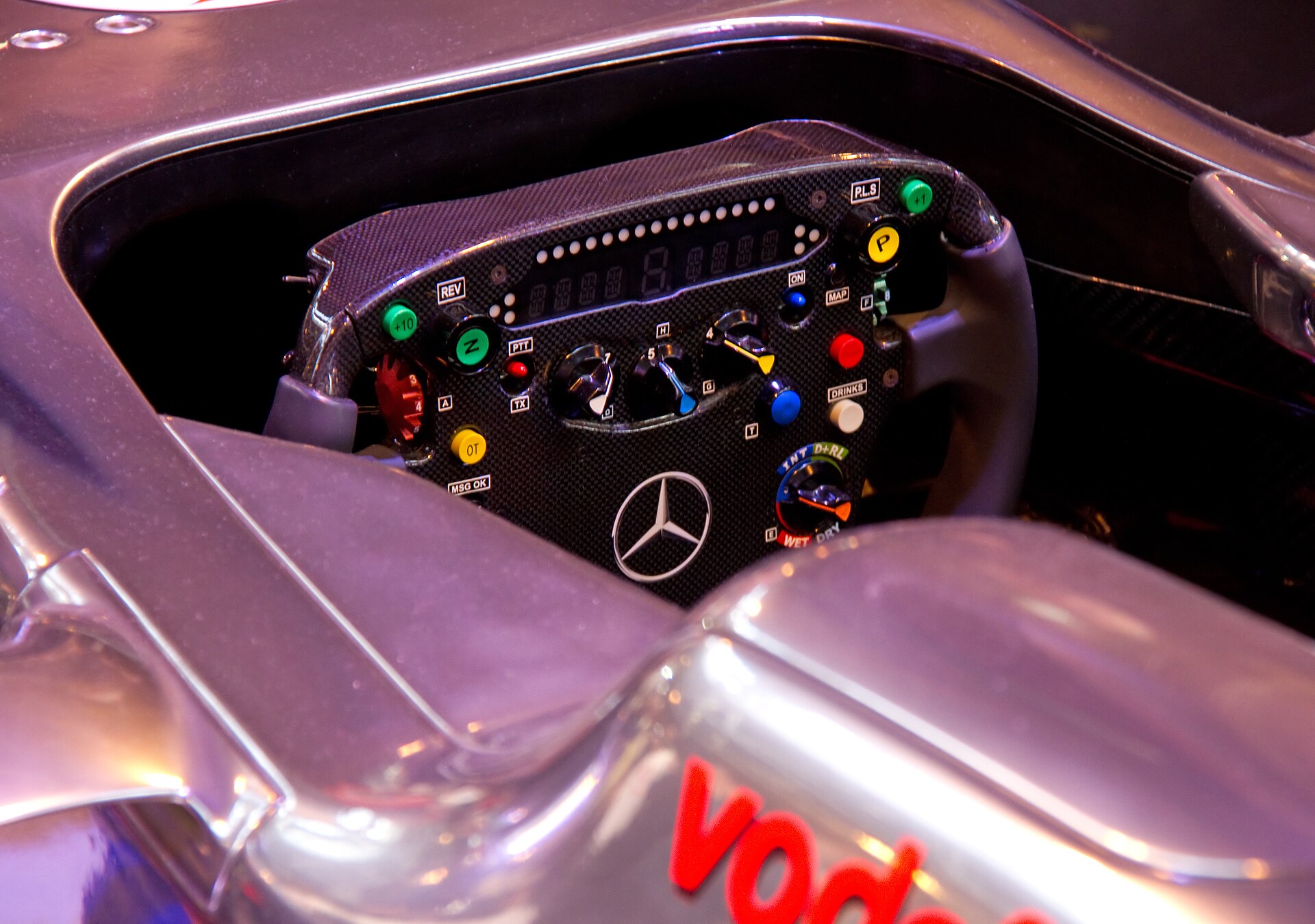
Newey settled the seating question on the FW18, and the layout became the standard still used today. The cockpit opening grew longer. The driver lay further back, the head sat lower, the pedals rose, and the steering wheel moved up. He described the result as sitting back in a bath with your feet on the taps.
Three gains arrived together. Air reached the engine intake behind the driver head more cleanly. The helmet sat lower, so flow onto the rear wing was tidier. The centre of gravity fell.
The consequence nobody planned proved more valuable. Raising the steering column cleared the space a driver needs to brake with the left foot. Jacques Villeneuve used it in 1996, and the technique spread through the grid. A packaging decision handed drivers a new control method.
That is the general rule for any car where a human body sets the constraint. Treat the body as an aerodynamic and mass variable, then check what the new layout makes possible that the old one forbade.
Foundational Literature on this Topic
Essential volumes on engineering, systems design, and sporting strategy.
How to Build a Car
Why it matters: Essential design and aerodynamic history across the active-suspension, V10, and modern hybrid eras.
Part memoir, part engineering masterclass from Formula 1’s preeminent car designer. Covers ground effect principles, chassis packaging, and the evolution of aerodynamic philosophy.
Find Edition & Availability →Race Car Aerodynamics: Designing for Speed
Why it matters: Foundational fluid mechanics textbook on wing profiles, diffusers, and ground effect.
A thorough engineering text explaining boundary layers, downforce generation, and vortex management for motorsport practitioners.
Find Edition & Availability →Tune to Win
Why it matters: Straightforward race engineer advice on chassis tuning and handling balance.
Classic, practical engineering thinking on spring rates, damper valving, and roll center geometry from legendary race engineer Carroll Smith.
Find Edition & Availability →Full Grid is reader-supported. When you purchase through links on our site, we may earn an affiliate commission at no extra cost to you. Editorial analysis, telemetry data, and sporting derivations remain strictly independent.