The Physics of Ground Effect Blow-Over: Aerodynamic Suction and the 3-Minute Medical Rule
Why ground effect floors transform from high-downforce suction into lifting bodies, and how trauma neurosurgery rebuilt trackside rescue.
Core Thesis
Ground effect racing cars are governed by a severe physical duality: as long as the underbody floor remains sealed parallel to the asphalt, venturi tunnels generate hundreds of kilograms of downforce. The instant that seal breaks through a curb strike or pitching collision, the low-pressure pocket collapses, transforming the floor into an aerodynamic sail. Professor Sid Watkins recognized that surviving high-energy ground-effect impacts depends entirely on establishing a patient airway within three minutes of kinetic energy dissipation.
Bernoulli Suction & Pitch-Induced Floor Stall
Underfloor streamline acceleration through the venturi throat and instantaneous suction collapse when ground clearance exceeds critical pitch angle.
The Aerodynamics of the Ground Effect Launch
Adrian Newey likens ground effect to a swan skimming millimeters above the water: wingtip vortices seal the airflow, creating intense suction beneath the profile. In Formula 1 underfloor venturis, air accelerates through a constricted throat, causing static pressure to plummet according to Bernoulli’s principle.
However, this suction is pitch-sensitive. If a car hits a curb or is tipped sideways by contact, air rushes into the low-pressure pocket from the side. The negative pressure differential disappears in milliseconds, and the oncoming 300 km/h air mass acts on the flat bottom, projecting the car upward into an aerodynamic blow-over.
The Le Mans 1999 and Valencia 2010 Precedents
The physical mechanism of blow-over was demonstrated vividly at Le Mans in 1999, when Mercedes-Benz CLR prototypes backflipped through the air three times over the weekend, and again at Valencia in 2010 when Mark Webber’s Red Bull struck Heikki Kovalainen’s Lotus at 310 km/h.
Simon McBeath, in Competition Car Aerodynamics, explains the physics: when pitch angle exceeds approximately 2.5 degrees, the stagnation point moves from the front splitter to the underbody leading edge. The front of the floor stops generating downforce and begins producing positive aerodynamic lift. Because aerodynamic force scales with the square of velocity, a car traveling at 85 meters per second generates enough lift to throw an 800-kilogram prototype 15 meters into the air.
The Three-to-Four Minute Rule
In Life at the Limit, Professor Sid Watkins established the foundational physiological constraint of motorsport medicine: when an impact causes respiratory arrest or airway obstruction, brain cells begin irreversible necrosis after three to four minutes without oxygen.
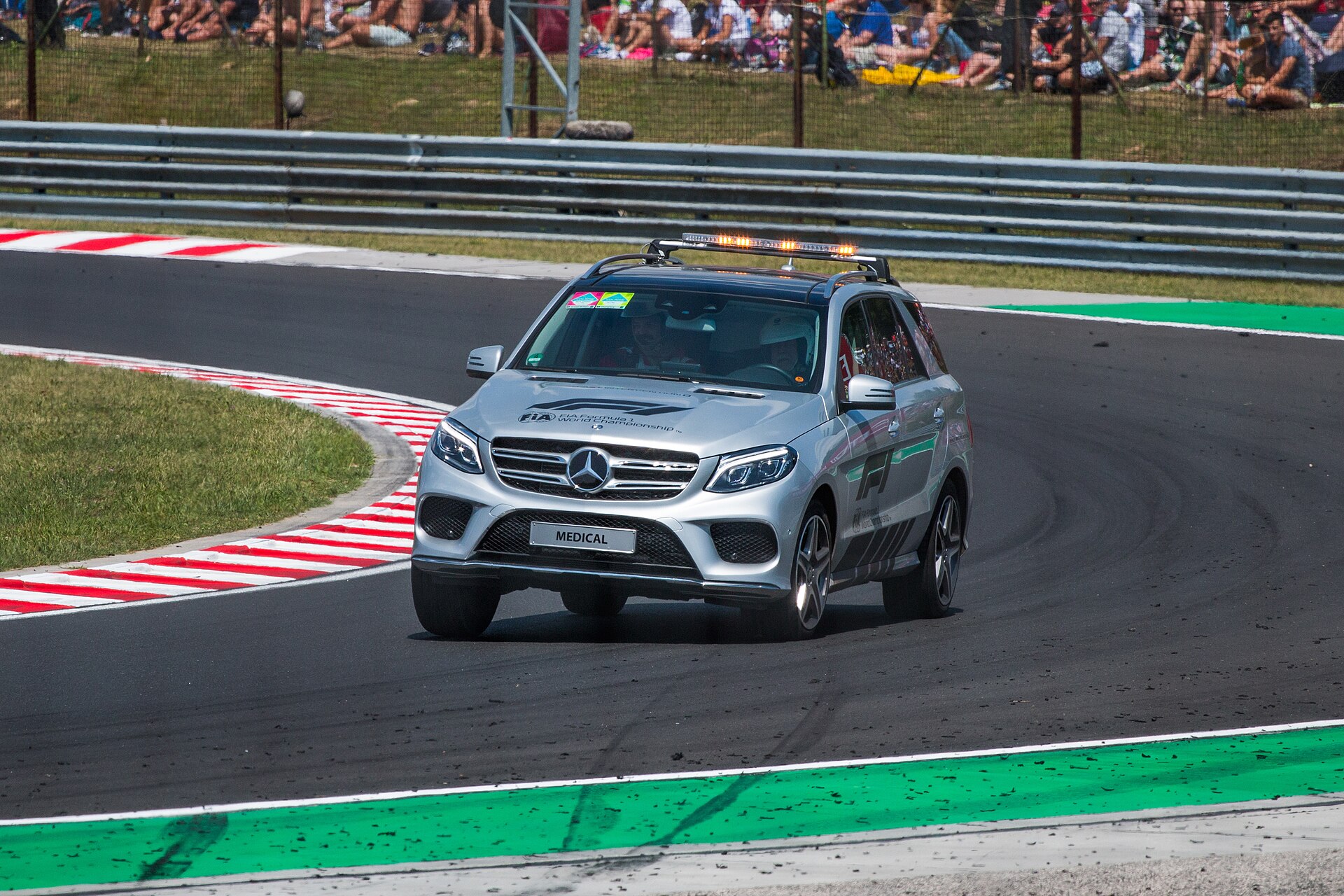
A hospital twenty minutes away with elite neurosurgeons is useless if the driver’s airway is occluded at the trackside. Every logistical decision in modern Formula 1 rescue, including the requirement for the FIA Medical Car to tail the 20-car grid on lap 1, derives from beating this 180-second clock.
The Response Chain and Decoupled System Failure
Watkins decomposed rescue operations into an interdependent chain: Alert, Dispatch, Arrival, Airway, Immobilisation, Extrication, Stabilisation, and Evacuation. Case reviews prove that when emergency response fails, it is rarely due to medical ignorance; it is a failure of communication dispatch or physical circuit access.
At Jerez in 1990 during Martin Donnelly’s crash, the lack of an interior service road delayed initial response. The Watkins reform mandated perimeter access roads and on-site resuscitation suites equipped to perform emergency tracheostomies directly on the grass.
The Technical Safety Partnership: Watkins and Newey
Following the tragic Imola 1994 weekend, the FIA formed the Expert Advisory Group on Safety, chaired by Watkins with Adrian Newey as a core member. For the first time in racing history, trauma surgeons and chief aerodynamicists collaborated directly: Watkins provided biological deceleration tolerance limits and head kinematics, while Newey translated them into carbon survival cell crush zones, cockpit collar foam padding, and raised chassis side protection.
Write the Standard for the Worst Venue
Watkins tests circuit standards against two extremes at once: Monaco and Watkins Glen. A requirement drafted to satisfy the easiest venue is ratified by the hardest one, which then fails the inspection.
So he writes the rule for the venue hardest to bring up to standard, because the good venues pass anyway. The same logic applies inside a single circuit. Measure the response time to the furthest, least accessible point, never to the pit lane.
At Jerez the dispatch link failed. A red flag carried no location information, on a circuit with no interior roads, and a response became a search. That is a property of the venue design rather than a training gap.
From 1994 the sport began to separate responsibility from culpability in the same way. Safety-critical components went to a named stress engineer who checks and countersigns. The designer no longer takes the safety compromise decision alone, which Newey counts among the best changes the sport has made.
Foundational Literature on this Topic
Essential volumes on engineering, systems design, and sporting strategy.
Life at the Limit: Triumph and Tragedy in Formula One
Why it matters: The definitive account of medical response, driver safety reform, and the Imola 1994 turning point.
A firsthand doctor’s chronicle of safety innovation and trackside trauma care from the 1970s through the 1990s by the FIA Safety Delegate.
Find Edition & Availability →How to Build a Car
Why it matters: Essential design and aerodynamic history across the active-suspension, V10, and modern hybrid eras.
Part memoir, part engineering masterclass from Formula 1’s preeminent car designer. Covers ground effect principles, chassis packaging, and the evolution of aerodynamic philosophy.
Find Edition & Availability →Competition Car Aerodynamics
Why it matters: Accessible wind-tunnel and CFD guide for understanding modern aerodynamic downforce.
Practical exploration of airflow management, front wing endplates, and underfloor venturi tunnels using real scale testing data.
Find Edition & Availability →Full Grid is reader-supported. When you purchase through links on our site, we may earn an affiliate commission at no extra cost to you. Editorial analysis, telemetry data, and sporting derivations remain strictly independent.